Four Types of Cenote, and Which One Fits How You Swim
Picking a cenote from a photo usually leads to the most photographed one. Gran Cenote earns its reputation.
- Gran Cenote is the best starting point for most visitors: shallow entry, calm water, and connected cavern passages with stalactites and turtles, about five minutes from central Tulum on the road toward Cobá.
- Dos Ojos is a cave system connected to the Sac Actun network; non-divers snorkel the open, sunlit cavern sections with a guide, while certified cave divers can go deeper into the network.
- Cenote Car Wash, Cenote Choo-Ha, and Cenote Xcanche are worth the extra drive for fewer crowds, lower fees, and in the case of Xcanche, a natural pairing with the Ek Balam ruins.
- Arrive before 10am at Gran Cenote and Dos Ojos; tour buses from Cancún and Playa del Carmen fill both between 10am and 1pm.
- Every cenote runs on cash, and most require biodegradable reef-safe sunscreen that staff check at the rinse station.
But Dos Ojos, forty minutes away, is a different kind of place: the surface access point to a cave network that draws certified cave divers from around the world. These are different days entirely, and confusing one for the other is easy to do when both look like postcard shots.
The Yucatán Peninsula holds around 6,000 cenotes. The ones near Tulum fall into four distinct structures, and which type you're walking into determines everything: how much light you'll have, how deep the water goes, and whether you need a guide with a certification or just a swimsuit.
Open-air cenotes are natural surface pools with full sky above them. Light pours straight in, the bottom is often visible, and there's no enclosed space to contend with.
These are the easiest entry point for anyone new to cenotes.
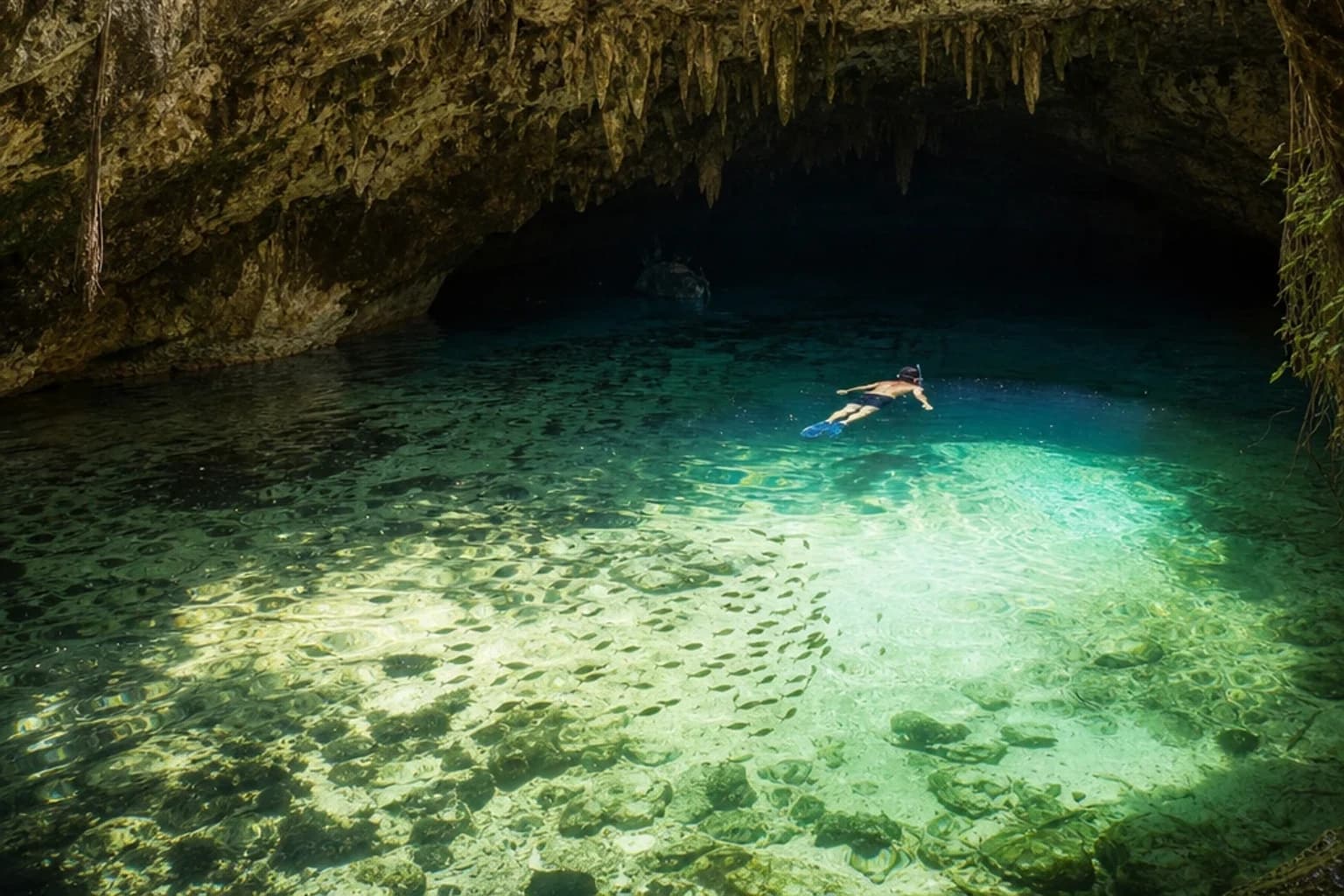
Semi-open caverns sit partially underground, with cracks or gaps in the rock that let daylight through in shafts and columns. Gran Cenote, just outside Tulum on the road toward Cobá, is this type: you swim in open water and can move into stalactite-hung passages where the light shifts and dims without going completely dark.
Non-swimmers can stand at the edges; snorkelers can work the cavern sections on their own.
Fully underground cenotes require descending a staircase into a cave pool. The sky disappears.
Snorkeling the open cavern portions is possible without a dive certification, but a guide is required at every one of these sites. The layout is genuinely disorienting once you're inside.
Technical cave systems go further. The full penetration routes through places like Dos Ojos connect into the Sac Actun network, a vast underwater river system that cave divers have mapped for decades.
These sections are off-limits without a cave diving certification, and that line is enforced.
The Maya considered these waters sacred: a clean water source and, in their cosmology, a passage to the underworld. Rituals took place at cenote edges for generations, and the rules around sunscreen, rinse stations, and guide requirements reflect that history.
Knowing which type you want before you show up is the one thing that prevents a wasted morning. An open-air cenote and a guided cave system are completely different days, and picking the wrong one because of a photo is a surprisingly common mistake.
If your morning is free and you want sea turtles alongside the cenote, a five-hour sea turtle snorkel and cenote tour picks you up at your hotel in Tulum between 8:30 and 8:50 in the morning and covers both in one trip: snorkeling with turtles in open water, then a guided swim through an underground cenote park hung with stalactites and crystal-clear fresh water. Snorkel gear, a bilingual guide, and food are all included.
Gran Cenote, Dos Ojos, and Calavera: What Each One Actually Delivers

Gran Cenote is about five minutes from central Tulum on the road toward Cobá, and it earns its reputation without much argument.
The water is calm and clear, entry is shallow with wooden stairs and platforms, and the connected cavern passages let snorkelers pass through stalactite formations and spot turtles without needing any cave experience. It works for beginners and is still genuinely rewarding for more confident swimmers.
Plan at least a few hours. There are services on site, a rest area for lunch, and enough above and below the surface to make a half-day stay feel right.
Dos Ojos sits about 40 minutes away, back toward Playa del Carmen, and it's a different kind of place. The name means "two eyes," referring to two sinkholes connected underground as part of the Sac Actun cave network, which cave divers have mapped for decades.
Certified cave divers can penetrate the full network. Non-divers access the open, sunlit cavern sections on a snorkeling tour, which still requires a guide even without a certification.
The water is exceptionally clear despite the darkness, with stalactites throughout and shafts of light through the rock.
The open cavern sections are striking even without going deeper into the system.
Combining Gran Cenote and Dos Ojos in the same day is doable, and people plan full mainland circuits that take in both. Each place warrants two to three hours, and the drive between them adds up in either direction from Tulum. If you have to pick one: Dos Ojos is the stronger choice for divers or anyone who wants something more dramatic; Gran Cenote is the right first cenote for most people.
Calavera, sometimes called Temple of Doom, is close to Gran Cenote and a fraction of the time investment. You enter through one large and two small skull-shaped openings in the rock, with a rope swing and a short swim once you're down.
It's the right stop when you have an hour or two and want the experience without committing to a half-day.
Booking through our links helps me keep finding you the best events and tours. I'm Ondees, your local best friend who finds what even Google can't, and I can't do it for free.
Quieter Cenotes Worth the Extra Drive

Want fewer tourists but still stay close to Tulum?
Cenote Car Wash, also called Aktun Ha, sits near Gran Cenote but draws considerably fewer visitors. The draws are specific: a rope swing, a five-meter jump platform, and a resident baby crocodile that moves freely around the site.
It's open 9am to 5pm.
Is the drive toward Cobá worth it?
The extra 30 to 40 minutes pays off at Cenote Choo-Ha if budget matters. It charges around 100 pesos per person, while cenotes closer to Tulum typically run 350 to 500 pesos.
The water is shallow and calm, the site has showers and changing rooms, and there's usually no queue.
Can you combine a cenote with ruins in one day?
Cenote Xcanche pairs naturally with the Ek Balam ruins. It's an open-air cenote fed by a waterfall, with zip-lines above the water and a swing jump alongside swimming.
The cenote entrance sits before the ruins ticket check, so both visits are independent and can be done in either order; the ruins entrance is about two kilometers away.
Further north toward Cancún, Cenote Jaguar, Nicte-Ha, Dos Ojos, and Sac Actun cluster along the same side road off Highway 307. Doing all four in a day looks clean on a map; in practice, each one warrants real time, and the full loop is a stretch.
Sac Actun is worth visiting with a guide even without a dive certification.
If avoiding the tourist circuits entirely is the point, the five-cenote jungle experience near Playa del Carmen puts you inside a private protected property where the cenotes stay off the standard day-trip map.
Groups are kept small, and a guide stays in the water with you the whole time. Goggles and life jackets are included.
It leaves from a meeting point near Playa del Carmen.
Families, Kids, and Non-Swimmers: The Honest Breakdown

The decision isn't just about who can swim. It's about how long everyone will last before someone needs shade, a snack, or a bathroom.
Gran Cenote is the clearest family pick. Wooden stairs and platforms replace the rock scramble that smaller kids find frustrating, and the water is calm enough that non-swimmers can stand in the shallows and look around.
There's enough shaded rest space to spread out between swims. It's built for a full morning, not a quick dip, which matters when you're managing gear, wet sandals, and a child who needs ten minutes to get in the water.
Cenote Azul, just north of Tulum off the highway, is open-air with shallow water for younger swimmers and a cliff jump for those who want more.
Both groups stay at the same place. It gets busy, so arrive early in the morning or wait until late afternoon.
Casa Cenote is an open channel running through mangroves near the coast, shallow in parts, with small fish visible in the clear water and calm enough for kayaking. Young children do well in the shallower sections.
The first half of the channel runs upstream, so even strong swimmers tire faster than expected; a life jacket makes sense for anyone. The return trip flows with the current and takes care of itself.
There's also a resident alligator toward the far end; staff know it well, but it's worth knowing before kids swim ahead.
Dos Ojos is for the confident swimmers in the group. The cave sections are darker, the water is deeper, and a guide is required for the open cavern snorkeling.
It's genuinely dramatic, but the energy of the place is more serious than a family splash stop and isn't the right setting for a child who isn't fully comfortable in open water.
For a group where swim ability and energy levels vary, Gran Cenote early in the morning covers what nearly everyone needs.
When to Arrive, How to Get There, and What It Will Cost
The window before 10am is the one that matters. Tour buses from Cancún and Playa del Carmen fill the most popular cenotes between 10am and 1pm, and Gran Cenote feels like a different place at 8am versus noon.
Most sites open at 8 or 9am.
Every cenote here runs on cash. Cards are rarely accepted, and entry fees add up faster than older guides suggest.
Gran Cenote is around 500 pesos per person. Dos Ojos is 350 pesos for the main cenote, or 700 pesos for all three sites on the Parque Dos Ojos grounds (Dos Ojos, Sac Actun, and Nicte-Ha).
Camera fees, locker rentals, and equipment charges are billed separately, so leave room in the budget.
Most of the cenotes worth combining in one day sit along the same side road off Highway 307, the federal highway connecting Tulum to Cancún. A rental car makes that routing practical; you move at your own pace without the per-trip negotiating that comes with taxis between multiple sites.
Taxis from Tulum town work fine for a single stop at Gran Cenote or Calavera, but the math shifts quickly once you're planning three or four sites.
Cenote Jaguar, Nicte-Ha, Dos Ojos, and Sac Actun all cluster on that same road. Fitting all four into one day is possible but genuinely tight; each cenote rewards real time rather than a quick look from the rim.
Why You Have to Rinse Off Before Getting In
The rinse shower at the entrance isn't a formality. Sunscreen, lotion, and perfume carry chemicals that don't belong in a freshwater system that filtered through Yucatán limestone over thousands of years.
Staff at most cenotes check the bottle, not just your word.
Use biodegradable, reef-safe sunscreen on cenote mornings, or skip it entirely and apply regular sunscreen after. Your hair gets wet too, most people don't expect that.
Bring cash, since most cenotes don't take cards, and water shoes if the paths between sites are hard on bare feet.
The Maya considered these waters sacred: a clean water source and, in their cosmology, a passage to the underworld, where rituals took place for generations. The cenotes near Tulum are surface openings into Sac Actun, an underground river network that continues well past where the light reaches.