First, what “Mayan ruins in Mexico” really means

Start with the map when choosing Maya ruins from Quintana Roo. Tulum stays close to the Caribbean route, while Chichén Itzá turns the ruins into the day’s main event: Tulum can share the day; Chichén Itzá needs its own.
- Maya is the better term for the people, culture, civilization and archaeological sites.
- Tulum places a walled Maya city above the Caribbean.
- Cobá unfolds through an inland network of visible sacbeob.
- San Gervasio centers low buildings and ancient paths on Cozumel.
- Uxmal fits a Mérida route, while Ek Balam pairs naturally with Valladolid.
The familiar search phrase is “Mayan ruins,” though “Maya ruins” is the better term: “Mayan” describes the language family, while “Maya” names the people, culture, civilization and archaeological sites. These cities aren’t remnants of a vanished people; Mayan languages remain spoken across southern Mexico and northern Central America, including Quintana Roo.
Choose by experience, not by a universal ranking

For a first encounter with the peninsula’s biggest-name site, choose Chichén Itzá. For a city that unfolds across inland terrain, Cobá and Ixmoja offer a broader, slower walk.
Tulum belongs to another category: a walled Maya city on a cliff above the Caribbean. It is also the most visited archaeological site in Quintana Roo, making it the clearest answer when the question is specifically about the state, not the entire peninsula.
Photographers get the coastal setting, while travelers with limited time can keep the visit close to a Riviera Maya itinerary. Families balancing ruins with beaches and cenotes may prefer one focused visit; repeat travelers can leave the marquee names behind and give smaller sites more room in the day.
Weather deserves as much weight as fame. Winter brings the most comfortable conditions for walking archaeological sites; the heat builds by April, and summer adds high humidity.
Chichén Itzá: make the long day count

Chichén Itzá’s ball court stretches 166 meters, taking the city beyond the familiar photograph of El Castillo. The Temple of the Warriors and Sacred Cenote expand the ceremonial landscape and reward time spent beyond the central pyramid.
From Tulum, the 149-kilometer drive takes about two hours each way on the free highway.
The commitment is greater from Cancún: Chichén Itzá sits 195 kilometers west, about two hours and 20 minutes away on Highway 180D.
Bring Mexican pesos or a Visa or Mastercard. Cash payments are accepted only in pesos, and card payments are split into two separate government charges.
The gates usually open around 8:00 a.m., though the schedule shifts occasionally. Be there near opening to give the city’s monuments the time they deserve.
Tulum Ruins: choose the coast and manage the crowd

Expect exposed paths with little shade.
The ruins sit just north of modern Tulum and 60 kilometers south of Playa del Carmen. From Playa del Carmen or Cancún, leave room for the drive instead of squeezing the site between fixed plans.
Aim for first thing or the final hour, especially with children, older adults or anyone sensitive to midday heat.
Typical hours run around 8 a.m. to 5 p.m.
Drivers arrive at a large parking area with souvenir stores and snack shops. From there, choose between walking and taking the bus toward the ticket office.
Carry water and wear a hat, sunscreen and comfortable walking shoes.
Cobá: follow the roads through a Maya city

Cobá sits inland in the jungle, roughly halfway between Tulum and Valladolid. Admission runs about 100 pesos (the figure shifts from time to time), and exploring its groups among five surrounding lagoons can take anywhere from a few hours to a full day.
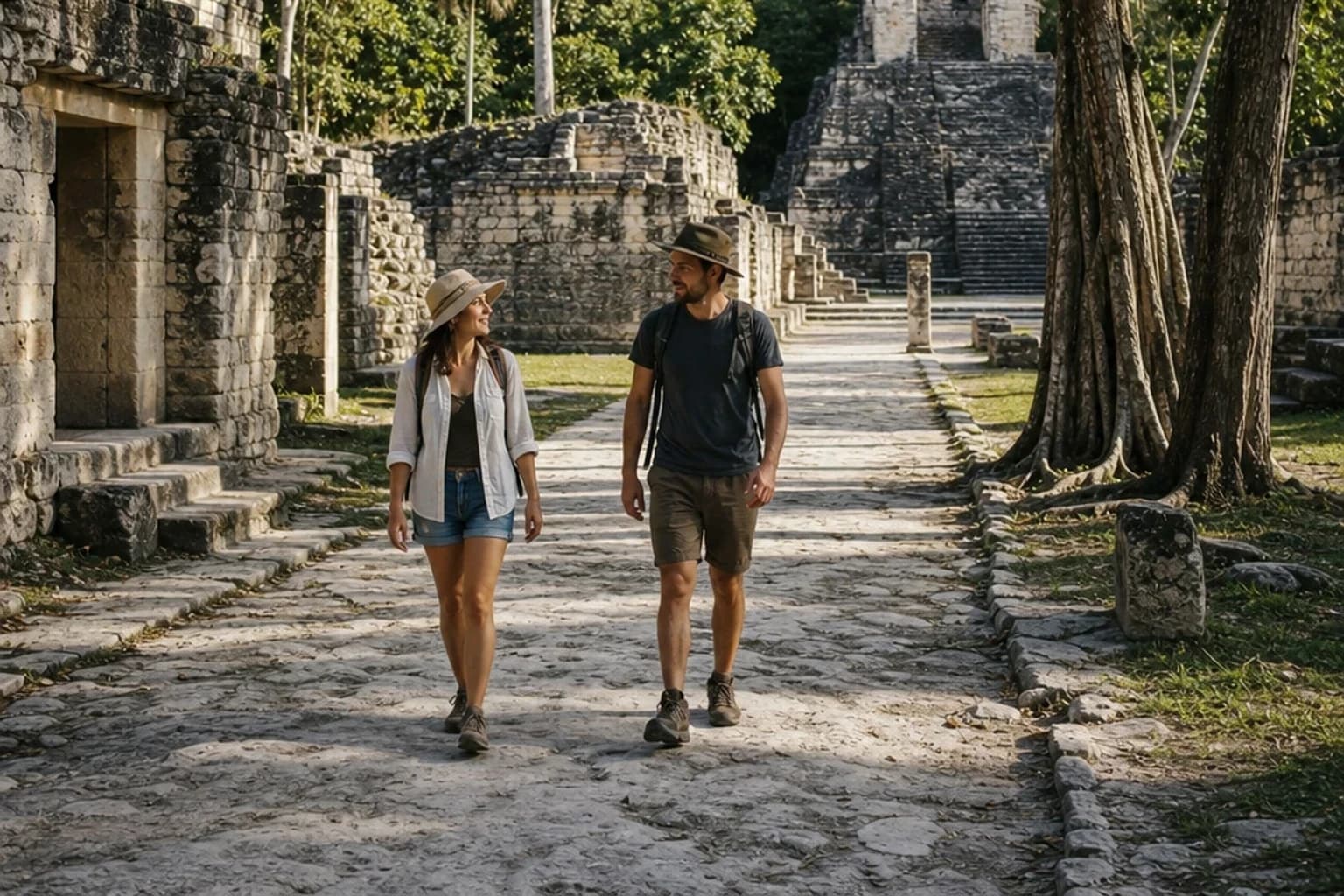
More than 50 sacbeob remain visible at Cobá. They make the roads the main event: the city reveals itself as a network, not a single pyramid.
Inside, the distance between structures shapes the visit: walking, renting a bicycle and taking a pedicab produce different days. Walking gives the roads their proper scale but takes more time; wheels leave more room for the farther groups.
If the day already includes a cenote or another archaeological zone, decide beforehand how much of the city you actually want to cover.
The entrance and larger pyramids draw most of the foot traffic. Smaller paths farther into the site open into quieter stretches with carved stones and fewer people, rewarding anyone willing to keep moving beyond the first cluster.
Cancún’s nearby ruin stops

Yamil Lu’um sits on Playa Marlin, a small seaside archaeological site tucked between two modern resorts. The ruins occupy Cancún’s highest point.
It’s the lightest commitment of Cancún’s four nearby options, especially if you’re already in the Hotel Zone and want to see Maya architecture without giving the whole day over to an excursion.
El Rey, Yamil Lu’um, El Meco and San Miguelito are all close enough to reach by taxi from the Hotel Zone.
El Meco is 8 kilometers north of Cancún, about 15 minutes by car, with admission around 70 pesos.
From the Hotel Zone, take a taxi, bus or colectivo to San Miguelito; entry runs about 80 pesos.
San Miguelito adds useful support facilities: the museum has restrooms, lockers and a restaurant.
Xel-Ha Ruins: look for frescoes, not spectacle

Xel-Ha Ruins begins with a detail that’s easy to spot from the highway: the Pyramid of the Birds, named for the large fresco still visible on its walls. It’s only a short walk from the entrance, and you can get relatively close to the colorful bird paintings.
It is also the largest pyramid at the site, but its surviving color matters more than its height.
The Castillo Group is a one-story maze of rooms you can walk through.
Here, the pleasure is in looking closely. Low rooms, passages and painted surfaces pull your attention inward instead of toward a skyline.
San Gervasio: low buildings and ancient paths

San Gervasio sits on Cozumel’s northern side, where low buildings connect through ancient paths; admission is about 205 pesos.
At Las Manitas, red handprints remain inside the structure, while the Temple of the Murals preserves brightly colored geometric patterns.
These small details reward a slower look rather than a race toward one headline monument. The archaeological area extends across two square miles.
Reaching the site from town is simplest by car.
If Cozumel is already part of a busy Riviera Maya itinerary, San Gervasio works best as one of the island’s main activities, not as a quick extra squeezed between multiple transfers.
Muyil: pair compact ruins with a lagoon landscape

Muyil, also called Chunyaxché, sits beside a lagoon at the edge of the Sian Ka’an Biosphere, 15 kilometers south of Tulum and 152 kilometers south of Cancún. Its compact archaeological zone trades the scale of a major ceremonial city for dense jungle and a closer connection to the surrounding wetlands.
Its buildings follow the Petén architectural style also found farther south at sites such as Tikal. Muyil was also one of the coast’s earliest Maya cities.
From Tulum, the drive takes about 20 minutes; allow just over an hour from Playa del Carmen or around two hours 15 minutes from Cancún.
From a northern base, pair Muyil with the Sian Ka’an side of Tulum, not another distant ruin; the road south already sets the direction of the day.
The visit doesn’t have to end at the stone structures. A boardwalk runs through the jungle toward a lookout over the lagoon, giving children and adults a change of scenery without adding another distant archaeological stop.
From Tulum, reach Muyil by colectivo or taxi.
Pack insect repellent for the jungle path, and keep cash handy at the site.
Add a bathing suit and towel if swimming is part of the day.
Chacchoben: the southern Quintana Roo option

Chacchoben sits near Mahahual, the Costa Maya cruise-port town. Several large pyramids frame its main plaza, with manicured lawns and well-kept trails.
Expect an open, orderly setting rather than the dense jungle feel of Cobá or Muyil.
Cruise traffic changes the rhythm. Chacchoben appears on many shore-excursion schedules, so groups can gather around the ruins when ships are in port.
From Mahahual or elsewhere in southern Quintana Roo, Chacchoben offers a substantial archaeological stop without turning the day into a northbound run toward the Riviera Maya. From Cancún, its location near the opposite end of the state makes far less sense for a casual day trip; save it for a stay around Mahahual or a broader southern route.
Uxmal and Ek Balam: extend the trip into Yucatán

At 80 kilometers from Mérida, Uxmal can anchor an architecture-focused day from the Yucatán capital without forcing a cross-peninsula dash from the Riviera Maya. Admission comes to about 545 pesos.
From Mérida, the drive is about an hour; from Cancún, it stretches to roughly four and a half hours. Uxmal also receives fewer visitors than Chichén Itzá, leaving more space to take in its architecture without the same level of crowding.
The Pyramid of the Magician and Governor’s Palace put Uxmal’s Puuc architecture at the center of the visit.
Nearby Kabáh can carry the same architecture-focused day farther into the Puuc region.
Ek Balam lies 174 kilometers west of Cancún, just north of Valladolid, so it belongs with a Valladolid stop rather than a Mérida-centered stay. Set aside about 550 pesos for admission.
The drive from Cancún takes about two hours and 15 minutes.
Here, the Acropolis makes the strongest visual case. Its decorated facades, stucco work and reliefs shift attention from sheer pyramid size to the surviving work on the building itself, while its friezes and murals reward travelers drawn to carved and painted detail.
The Acropolis can be climbed, though its staircase is steep. From the top, the view opens over the green Yucatán plain, adding a broad landscape to the close-up stucco and relief work below.